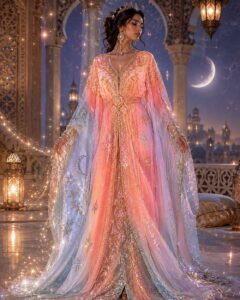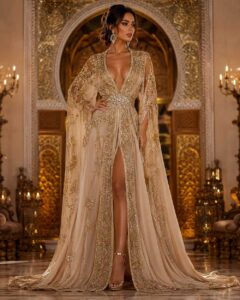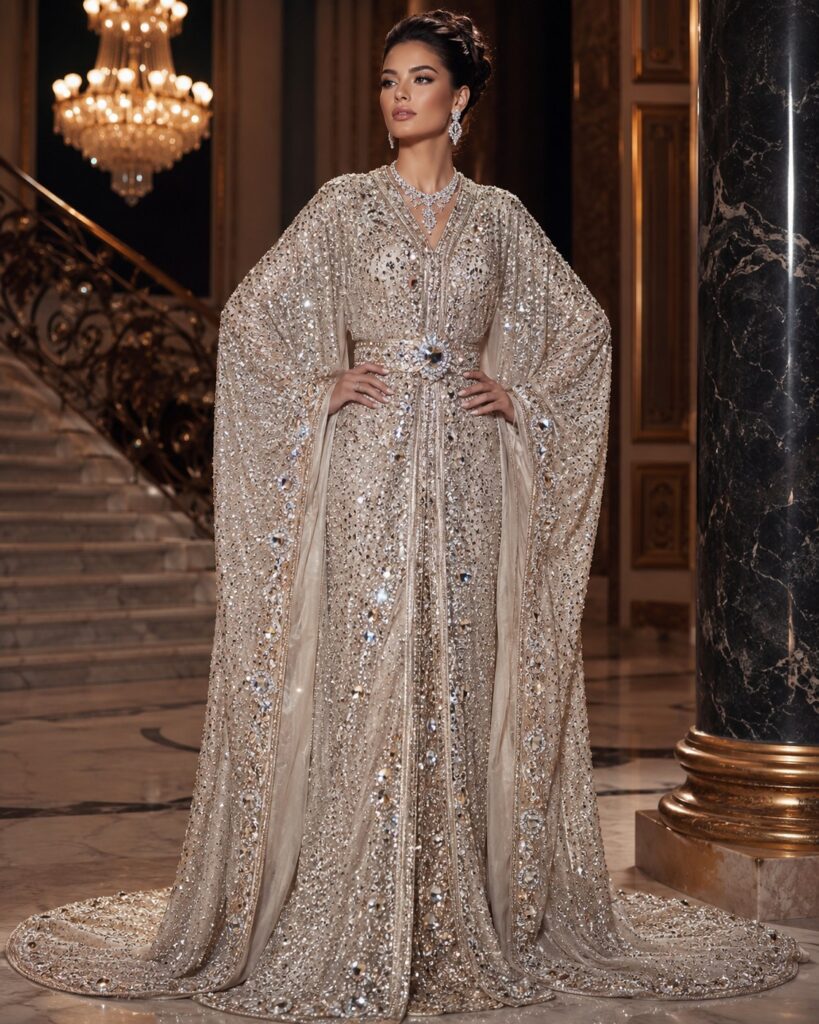
The Diamond Caftan by Asmae
The First Garment of Its Kind
The Diamond Caftan is not only a caftan decorated with diamonds. It is not a silk robe finished with crystal embroidery, but a traditional garment enhanced by precious stones.
It is something far more extraordinary: a caftan mainly made out of diamonds.
Because of this, the Diamond Caftan has never truly existed before. Its originality is not only artistic or cultural; it is financial, material, and symbolic. The magnitude of its price places it beyond fashion, beyond jewelry, and beyond ordinary definitions of luxury. It is a garment whose value is so immense that its very existence changes the meaning of what clothing can be.
For centuries, the caftan has been associated with elegance, ceremony, and heritage. It has been worn across cultures as a flowing garment of dignity and beauty, often made from silk, velvet, brocade, or other fine fabrics. In Morocco and throughout North Africa and the Middle East, the caftan has long represented refinement, celebration, and craftsmanship. Its beauty traditionally comes from fabric, embroidery, cut, and the skilled hands of artisans.
The Diamond Caftan begins with that history, but it does not remain within it. Instead of being sewn from cloth, it is conceived as a wearable structure formed from diamonds themselves. Every surface, every line, every movement of the garment is defined by precious stones. The caftan’s flowing shape remains, but the material has changed completely. Fabric gives way to brilliance. Thread gives way to light. Ornament becomes structure.
This is what makes the Diamond Caftan unprecedented. Luxury garments have been embroidered with gold. Royal robes have been decorated with pearls. Couture gowns have carried crystals, gemstones, and rare embellishments. But a caftan made out of diamonds belongs to a different category entirely. It is no longer simply a garment with jewels attached to it. It is jewelry transformed into clothing.
Its price is therefore not incidental. It is central to its identity. The value of the Diamond Caftan comes from the sheer quantity, rarity, and brilliance of the diamonds required to create it. Each stone contributes not only to the appearance of the piece, but to its staggering worth. The magnitude of the price becomes part of the design itself, announcing that this caftan is not intended for ordinary ownership, ordinary occasions, or ordinary comparison.
The name “Diamond Caftan” carries a literal meaning. It describes a garment built from one of the world’s most desired materials. Diamonds symbolize endurance, status, purity, and permanence. When shaped into a caftan, they create a contradiction that feels almost impossible: a soft, flowing silhouette made from the hardest natural material on earth. That contrast is part of the caftan’s power. It combines grace with strength, tradition with extravagance, and cultural memory with unimaginable wealth.
To look at the Diamond Caftan is to see light arranged as clothing. Its surface would not merely sparkle; it would radiate. Every movement would shift reflections across the body, turning the wearer into the center of an atmosphere rather than simply the wearer of a dress. The caftan would not depend on color, print, or embroidery in the usual sense. Its design language would be brilliance itself.
Because it is made out of diamonds, the garment becomes more than fashion. It becomes an object of art, an architectural achievement, and a symbol of extreme exclusivity. It challenges the boundary between what is worn and what is collected. It raises the question of whether a garment can also be a treasure, whether clothing can become an asset, and whether fashion can exist at the same level as royal jewels or historic artifacts.
The Diamond Caftan also transforms the idea of ceremony. A traditional caftan is worn to mark important moments: weddings, celebrations, grand entrances, and cultural events. The Diamond Caftan would not merely accompany such a moment; it would create the moment. Its presence would define the occasion. Before a word was spoken, before a ceremony began, the garment itself would announce rarity, power, and spectacle.
Its unprecedented nature lies in the fact that no ordinary standard can measure it. It cannot be compared to a designer dress, a jeweled gown, or a luxury accessory. Its price alone removes it from those categories. A caftan made from diamonds is not expensive in the usual sense; it is monumental. Its cost is so great that it becomes part of the story, part of the legend, and part of the reason the piece has never existed before.
The Diamond Caftan is therefore not just a new garment. It is a new category. It is the fusion of traditional caftan design with the material language of high jewelry. It preserves the recognizable elegance of the caftan while replacing fabric with diamonds, creating something both familiar and impossible.
To wear it would be to wear wealth in its most visible form. To own it would be to possess something beyond fashion’s normal limits. To create it would be to make history.
The Diamond Caftan has never existed before because its price, material, and ambition are unlike anything that has come before it. It is not a caftan inspired by diamonds. It is not a caftan decorated with diamonds. It is a caftan made out of diamonds — a garment of light, rarity, and unmatched value.